Showing posts with label recipe. Show all posts

Wednesday, July 31, 2013

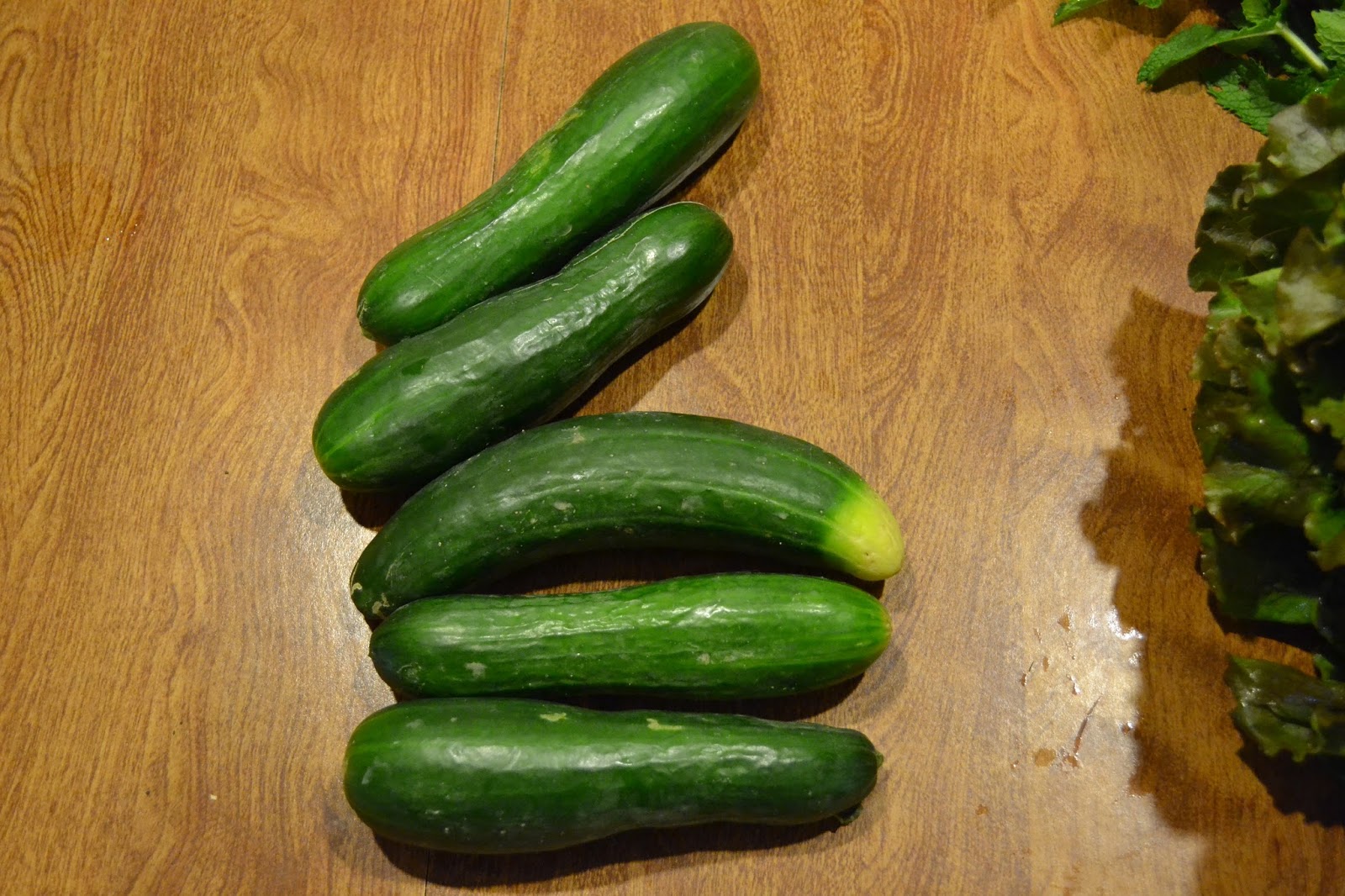
Pickled Cucumbers

Despite the title, this is not a recipe for pickles. At least, it's not a recipe for the kinds of pickles that you stick in a jar and leave in your root cellar, assuming you have a root cellar in which to put jars of pickles. Rather, this is a recipe for marinated cucumber slices, a little like the pickled beets we love so much.


This is a recipe Brian grew up with, and I must admit that it is a perfect summer recipe. The cucumber is juicy and the sauce is tangy, and the combination is light and refreshing.

Pickled Cucumbers

Ingredients:
Cucumber
Onion
Mayonnaise
White vinegar - half as much as mayonnaise
Salt and pepper to taste

Steps:
1. Slice cucumbers thinly
2. Slice 1/2 onion, also thinly
3. Mix mayonnaise, white vinegar, salt, pepper thoroughly, add cucumber and onion and mix until coated
4. Serve cool

Thursday, July 18, 2013

Scape Artist: A Deluge of Vegetables

I know I mentioned recently that all these weeks have been running together a bit, and that we're posting all of these photos and recipes after the fact. We get a lot of vegetables from the CSA, and while we have managed to eat it all so far, sometimes it takes more than a week to get through a week's worth of vegetables.

And sometimes we just throw the contents of our entire fridge into one dish.


Right around week three in the CSA we began getting squash and zucchini. A lot of squash (and zucchini). Well, between week three and week four, we found ourselves with several pounds of squash, as well as quite a few garlic scapes. (We still hadn't actually used the garlic scapes from week two yet, but they held up  very well, and we got more garlic scapes in week four.)

Side note: I am a huge fan of garlic in all forms, but before receiving them in my week two loot, I had never even heard of scapes. Garlic scapes are the curly flower stalks that grow up from the bulbs of some kinds of garlic. And they taste (surprise!) like garlic, but milder. They can be eaten just about any way that you would eat garlic, and some that you probably wouldn't, like raw, chopped, on a salad. Unless you'd eat garlic raw, on your salad, in which case I wonder about you.
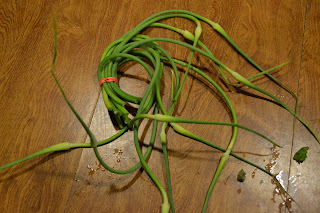
The few. The curly. The scapes.
So Brian and I were looking at the small mountain of squash in our kitchen, pondering how we were going to consume it all, and suddenly, without a word, Brian leaped into action. He threw some olive oil in a pan, and began chopping, dicing, and slicing like a madman.

The dish that emerged from the frenzy in the kitchen used just about all our remaining vegetables (that week, anyway, we're never low on veggies for long these days), and thanks especially to the shallots and scapes, it was ridiculously delicious. We consumed every last ounce.

It's surprisingly simple, and can easily handle, apparently, very large quantities of squash.

Sauteed Squash and Zucchini with Shallots and Garlic Scapes

Ingredients
Shallots, finely chopped
Summer squash and zucchini, sliced
Garlic scapes, cut into 1-inch segments
Olive oil
Salt and pepper to taste

Steps:
1. Heat olive oil in a large pan
2. Sautee shallots in oil
3. Once shallots are translucent, add garlic scapes and squash
4. Sautee until squash is soft, add salt and pepper to taste
Wednesday, July 17, 2013

Turnip Puree and Other Lies

Brian decided to try something different with the turnips we got this week, so he made a turnip puree. A delicious dish that tastes and feels somewhat like a tangy, buttery, mashed potato.


The only time I've ever encountered a turnip puree was in a very fancy restaurant. It was the kind of tiny-portioned place where your serving of turnip puree is just a tablespoon or two artfully smeared on the plate underneath your very expensive ounce of steak. It seemed the kind of dish usually served with asparagus and mushrooms whose names I can't pronounce. Or, for some reason, with frisee.

Naturally, I assumed that turnip puree was something Really Fancy. And that being Really Fancy, turnip puree would be complicated to make. That it would require more than 3 ingredients.

Lies, all lies. Turnip puree is one of the easiest recipes we have tried.

Turnip Puree

Ingredients:
Turnips
Butter
Salt and pepper

Steps:
1. Boil turnips until soft
2. Put turnips in food processor, add salt, pepper, and butter to taste, and puree

Thursday, July 4, 2013

Pesto Pasta

When I realized that we had both fresh basil and peas in the house, I got very excited. One of my absolute favorite recipes, what I like to call Pesto Pasta, calls for both of those. Plus other personal favorites spinach and pine nuts. Also exciting? Fresh peas are delicious.


This recipe is one of my all-time favorites for a lot of reasons. It packs a flavorful punch, it can be eaten hot or cold, and, loaded with spinach, peas, and pine nuts, it's a pretty healthy, but filling dish. In addition, it's easy to tweak the ingredients as you like, or to scale up the recipe and make a whole vat. Then you get to eat it, hot or cold, all week.

If you're wondering where the fresh basil came from, I'll tell you tomorrow.

I mean just look at this beautiful dish:
Pesto Pasta

Ingredients:
basil
pine nuts
salt
pepper
olive oil
noodles (we usually use bow-tie)
spinach
peas
mayonnaise - about half as much as you have pesto
lemon juice - maybe a tablespoon

Steps:
1. Make the pesto - combine basil, pine nuts, salt, pepper, and olive oil in food processor or blender, blend until you have a fine thick liquid
2. Cook pasta
3. While cooking pasta, combine pesto, mayonnaise, lemon juice, and a little more salt and pepper
4. Cook peas and wilt spinach, and, if you love pine nuts as much as I do, you can add more whole nuts here
5. Combine in a large bowl pasta, peas and spinach, and pesto mayonnaise sauce
6. Serve hot or cold - it's great both ways!

Update:
After an ill-fated joyride and the heroic efforts of search and rescue teams, the photo of the pesto pasta has been safely recovered:


Wednesday, July 3, 2013

Kale 2 Electric Boogaloo, This Time with Garlic

We picked up some kale again this week, although this time it was Russian red kale. I'm really not sure what the difference between regular kale and Russian red kale is, except that Russian red kale looks suspiciously like a kind of lettuce.


While regular kale, if you recall, does not.


Brian pointed this out when he got home that evening, and I swore up and down that I grabbed the bag labeled "kale" at the farm stand. In his defense, this wouldn't have been the first time I mistakenly grabbed the wrong veggie, but I was extra careful this time. "I swear I grabbed the kale. Like there was an arrow pointing to it with the word 'Kale!' With exclamation points and everything."

So we agreed to just cook it as if it were kale, and, lo and behold, it worked. Because it was kale.

To mix things up a little, we did not use bacon this time, but whipped up a delicious garlic butter kale. It also happens to be an Insanely Easy Recipe.


Butter and Garlic Kale:

Ingredients:
Kale
Garlic
Butter
Salt and Pepper

Steps:
1. Melt butter in pan
2. Add minced garlic and kale
3. Sautee, stirring frequently, until kale is wilted
4. Add salt and pepper
5. EAT

Tuesday, July 2, 2013

Fennel, ugh

I don't like fennel. Which, surprisingly, marks a first for this experiment. Up until now, I haven't run across any vegetables I don't actually like. I've met a couple that I didn't know very well, and at least one complete stranger, but this is the first time I've come across a vegetable that I actively dislike. Fennel. (I narrow my eyes and glare.) Fennel.


This is fennel. Or, more accurately,


This is the part of the fennel that people actually eat. I've yet to be convinced that any of them like it. You see, fennel tastes a lot like black licorice, which is, naturally, disgusting. I mean who on earth actually likes the taste of black licorice? (In case you're wondering, I also vehemently dislike anything having to do with anise, or with actual licorice, which I only found out today is a completely unrelated plant as well.)

Brian promised to find a fennel recipe that I would be able to tolerate. (He did not promise I'd like it.) So in the interest of trying new things, as well as the quest to use all of our vegetables, I gave his Roasted Fennel a shot:


The verdict? Cooked this way, I can actually enjoy fennel. It's like that weird uncle you don't really like, but who is pretty funny once a year at Thanksgiving. I wouldn't seek it out, but roasting it in large pieces does, as with most bulby vegetables, mellow the flavor quite a bit. And the spicy seasonings were a tasty distraction. I imagine the spice would, if the flavor of fennel were palatable, complement it nicely.

Brian, who has no prejudice against fennel, declared it a "solid fennel recipe." Verbose, that one.

So if you must eat fennel, try it this way:

Roasted Fennel:

Ingredients:
Fennel
Olive Oil
Salt
Pepper
Parmesan Cheese
Crushed red pepper flakes

Steps:
1. Pre-heat oven to 350 degrees
2. Cut fennel into eighths or quarters, depending on size of bulb
3. Lightly oil a baking sheet (with the olive oil)
4. Place fennel pieces on sheet, drizzle oil on top, sprinkle generously with salt, pepper, red pepper, and Parmesan cheese
5. Bake until the fennel is soft (about 20 minutes)

Friday, June 28, 2013

Cilantro Lime Beans

Cilantro tends to be one of those love-it-or-hate-it kind of foods (which is genetic). As for me, I love cilantro with a passion unseemly between woman and herb, and I am entirely unapologetic about it. If it has cilantro in it, I am on board.

Just look at that. Doesn't that look delicious?

I requested Brian use the cilantro in one of my favorite dishes, Cilantro Lime Beans. Cilantro pairs brilliantly with lime. The two are basically a culinary crime-fighting duo.

This is the only superhero pose I can reliably draw.

This recipe needs to be planned in advance, as the beans generally need to soak overnight, but beyond that it is a very simple recipe. In addition, you get easy meals for the next few days because this recipe keeps well, and makes a lot of leftovers. Lunch the next day? Bowl o' beans. Don't have time to make dinner? No problem, you've got beans!

Cilantro Lime Beans:

Ingredients:
A lot of pinto beans
Cilantro
Lime juice

Steps:
1. Follow the instructions on the bag of dried beans for hydrating your beans. Add a little lime juice and cilantro to the water when you let them soak overnight.
2. Continue to follow cooking directions on bag of beans, adding more lime juice and cilantro.

Wednesday, June 26, 2013

Insanely Easy Cabbage Recipe

Cabbage is awesome. It's healthy, versatile, and tasty. You can eat it raw, steamed, pickled, sauteed, braised, stewed, and probably about a hundred other ways. It's got all kinds of vitamins in it, apparently, and can sometimes help fight off cancer. Or prevent cancer. One way or the other, it does something bad to cancer.


The head of cabbage we got this week was, in a word, adorable. It is the tiniest head of cabbage I have ever seen, and I would like nothing more than to give it a tiny hug. Actually, that's a lie. I would rather eat it. (Fortunately, I can do both.)


I know this picture does not effectively illustrate the adorableness or tininess of this cabbage. So I will.

Brian has been itching to make stuffed cabbage leaves, but with a cabbage this small, they'd end up being the size of postage stamps, but it's early in the cabbage season, so we'll wait on those until the cabbages have gotten a wee bit bigger. I love a good steamed cabbage, which also happens to be an Insanely Easy Recipe. Perfect for a hectic week.


Steamed Cabbage

1. Wash and chop your cabbage, and toss in a pot with a vegetable steamer and a couple of inches of water in the bottom.
2. Cover the pot and boil until cabbage is tender. Serve hot, with butter.

Tuesday, June 25, 2013

Beauty and the Beets

Beets. Beets! Denizens of salad bars everywhere. We are huge fans of the beet.


They are most commonly known for their red bulbous roots, but the greens of the beet are edible too. This week? Too much work! So we tossed the greens and made my personal favorite incarnation of the beet, the marinated beet.


Marinated Beets

Ingredients:
beets
few tbsps vinegar
1/2 tsp mustard
1 tbsp olive oil
pinch of sugar
pinch of salt
pepper to taste

Steps:
1. Boil peeled beets until they slide easily off a fork.
2. Slice cooked beets
3. Mix all non-beet ingredients in a bowl
4. Add beets, let sit for 30 minutes
5. Devour

Tuesday, June 18, 2013

Elusive Fava Beans

I have found fava beans in quite a few recipes recently. With a name like fava, they sound somehow exciting. Like they're the party bean. Not just fava beans, but fava! beans. So on a recent trip to the grocery store, I tried to find some. I scoured the shelves and prowled the produce section like some kind of vegetable stalker, but to no avail. Seems our grocery store doesn't sell them. Thus I found myself pretty excited this week when we got some in our loot, if only to discover what, exactly, a fava! bean was.

Turns out (and this is a big surprise, so hang on to your seat now) they're beans.

Those aren't the actual beans, of course. Those are just the pods. Bean pods. Like pea pods. To get to the elusive fava beans, you must not only get them out of the pods, but get them out of a second shell around each individual bean. There are a variety of ways to do this, and while it's not hard, it is a bit labor-intensive, which is apparently why people don't buy fava beans.

Once you do get past the second inner shell, they are really just beans, not much different than other beans. For an approximate idea of their size, here is a highly accurate comparison with a pea.

We are both pleased to report that our first experience with fava beans was a good one. They are quite delicious, with a warm, nutty flavor, and they're excellent prepared very simply with a little butter. Brian says "they are my favarite."


Buttered Fava Beans with Chives

fava beans
butter
chives
salt and pepper (you guessed it) to taste

Steps:
1. Sautee beans in butter
2. Add chives, salt, and pepper

Monday, June 17, 2013

Kohlrabislaw

What is kohlrabi? Excellent question! I have no idea.

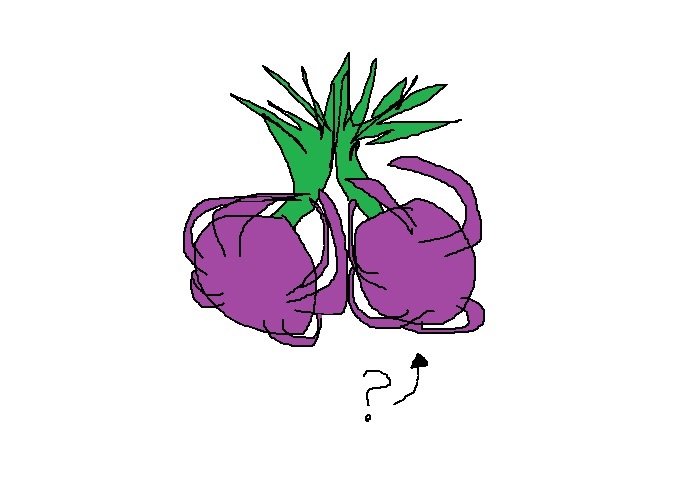
Seriously, this vegetable is weird. This is my best approximation.


If you can't make heads or tails of this picture, you're not alone. Check out a search for images of kohlrabi to make more sense of it. Some kohlrabi is actually a green color, which makes marginally more sense, but we got the purple kind this week, and now I can't quite shake the feeling that we're about to eat the alien opera singer from The Fifth Element.

Image from film The Fifth Element, obviously.

According to the 10-second search I did, kohlrabi is a vegetable in the cabbage family. I find this a little hard to believe, since it looks nothing like cabbage. In fact, it looks about as much like cabbage as kale does, which is amusing because kale is apparently also in the cabbage family. Remember kale?


So all we know about this vegetable is that it is related somehow to both cabbage and kale, that it looks like an alien, and that apparently, it tastes something like broccoli stems. With no idea what to do with it, we looked up a random recipe and made kohlrabi cole slaw. Kohlrabislaw, if you will.

As it happens, kohlrabi may look weird, but it tastes delicious. In Brian's own words it was "undoubtedly the  best non-cabbage-based slaw I've had this year." Which begs the question how many non-cabbage-based slaws has Brian had this year.

Kohlrabislaw (with apples)

1 or 2 kohlrabi bulbs
1 or 2 apples (gala apples worked well for this)
1/4 cup mayonnaise
1 tbs plain yogurt
1 tbs lemon juice
1/2 tbs dijon mustard
1/2 tbs sugar
salt and pepper to taste

Steps:
1. Peel kohlrabi and cut into little slivers
2. Cut core out of apple and also cut into little slivers. You can leave the peel on if you like, it is tasty.
3. Mix remaining ingredients, toss with chopped kohlrabi and apples

Sunday, June 16, 2013

Bacon delivery system

You have probably already heard of kale. It has been very popular of late. Some people like to bake it into a crispy chip-like snack food. Others like it sauteed, collard-green-style. Regardless of how you cook it, in our opinions it is a highly underrated vegetable. It's a dark leafy green, and despite our high-quality illustration, it looks nothing like broccoli.

Kale was no mystery to us, but we were damned excited about getting some. Already knew what we wanted to do with it. Because sauteed kale is an excellent excuse to cook bacon.

So one night, after we got The Kid to bed, Brian cooked the kale while I did something extremely productive and not at all a waste of time. A few minutes later, when the kale was done, Brian comes over and asks a question I always love to hear.

"Would you like a glass of wine?"

So we popped open a bottle of wine, one thing led to another, and not a shred of kale or crumb of bacon survived the night. I think Brian may have licked the bowl.


Sauteed Bacon Kale

Ingredients:
lots of kale, chopped
6 strips bacon
1/4 cup apple cider vinegar
1/8 cup lemon juice
1 tsp-ish sriracha
generous pinch of red pepper flakes
salt and pepper to taste

Steps:
1. Fry up 4 strips of bacon
2. Remove bacon from pan, add last 2 strips of bacon, cut up into little bits, and fry 'em up until extra crispy
3. Eat first 4 strips of bacon
3. Add chopped kale to pan
4. Once kale has wilted, add vinegar, lemon juice, sriracha, red pepper flakes, salt, and pepper. Cover pan, and cook until tender (about 15 to 20 minutes)

Monday, June 10, 2013

The mysterious case of the disappearing green garlic

We are both quite familiar with garlic. There is little we cook that does not have garlic. Green garlic is simply the young shoot of garlic that, if it were left to mature, would turn into the big bulb of garlic that ends up in your marinara sauce. It has a milder garlic flavor, or so the literature informs me. It looks a little like this:


Garlic is garlic, so we chopped it up nice and fine, and tossed it in the slow cooker to make roast beef and French onion soup.


Slow Cooker Roast Beef and French Onion Soup

Beef roast - any size you want
Beef stock
1 large Vidalia onion
2 bulbs green garlic
2 Tbsp Worcestershire sauce

Steps:
1. Mince garlic into small pieces
2. Chop onion - you can use whatever size onion you'd prefer, but Brian and I use strips of onion about 1-2 inches long
3. Toss roast, onion, and garlic in slow cooker. Add Worcestershire sauce, and fill remaining space in slow cooker with beef stock
4. Cook in slow cooker until roast beef is falling apart

This recipe is flexible. If you want more soup, use a smaller roast. If you want more beef, a larger roast. You can adjust the amount of onion, garlic, and Worcestershire sauce as needed.

The fresh green garlic was amazing in this dish. It's a recipe we've done before, with regular garlic. The green garlic was indeed milder, and added an almost delicate note to the broth, without being overpoweringly garlicky. If you can get your hands on some green garlic, I highly recommend it in this dish.


My brother lettuce, and my other brother lettuce

Lettuce. What is there to say about lettuce? It's delicious when it's fresh, and fresh is really all we're looking for in lettuce. Fresh, and green. Crisp is good. It was all those things.

It probably has an actual name, but I'm not sure what that might be. Plain lettuce? Regular lettuce? It looks like this:


We also got arugula. Arugula is a peppery, slightly bitter lettuce, which looks almost nothing like this:


But lettuce, eaten raw, is very boring to write about. Just rinse and eat. So instead, try this dijon mustard vinaigrette we made this week, to eat on your lettuces.

Dijon Mustard Vinaigrette

1 Tbsp dijon mustard
1 Tbsp some kind of vinegar
1/2 Tbsp lime juice
Salt and pepper to taste
Olive oil

Steps:
1. Whisk together all ingredients except olive oil
2. Slowly whisk in olive oil until you have the volume of dressing you need

The turnips were the first to go

First to be devoured were the turnips. And let me say, turnips, when prepared well, will always be the first devoured.

We took lovely shots of all of our vegetables before and after cooking this week. However, as a result of some technical difficulties or possibly just some technical stupidities, we lost most of our pictures. In the place of photos, please enjoy these lovely artist's renderings.


I have never had turnips before, that I am aware of.  Brian, however, has, and could hardly wait to get his hands on them.  With only a few simple ingredients, he turned them into these.


Here's how (this one's easy):

Sauteed Turnips

1 Tbsp butter
Turnips

Step 1: Sautee turnips in butter.

Done!